# Agents are available in the autogen.agents namespace
from autogen import ConversableAgent, register_function, LLMConfig
from autogen.agents.experimental import SlackAgent

# For running the code in Jupyter, use nest_asyncio to allow nested event loops
#import nest_asyncio
#nest_asyncio.apply()

llm_config = LLMConfig(model="gpt-4o-mini", api_type="openai")

# Our Slack credentials
_bot_token = "xoxo..."  # OAuth token
_channel_id = "C1234567"  # ID of the Slack channel

# Our tool executor agent, which will run the tools once recommended by the slack_agent, no LLM required
executor_agent = ConversableAgent(
    name="executor_agent",
    human_input_mode="NEVER",
)

with llm_config:
    slack_agent = SlackAgent(
        name="slack_agent",
        bot_token=_bot_token,
        channel_id=_channel_id,
    )

# We get the registered tools and register them for execution with the tool executor
for tool in slack_agent.tools:
    tool.register_for_execution(executor_agent)

# Weather function
def get_weather():
    return "The weather today is 25 degrees Celsius and sunny, with a late storm."

# Register for LLM recommendation with our slack_agent and for execution with our executor_agent
register_function(
    get_weather,
    caller=slack_agent,
    executor=executor_agent,
    description="Get the current weather forecast",
)

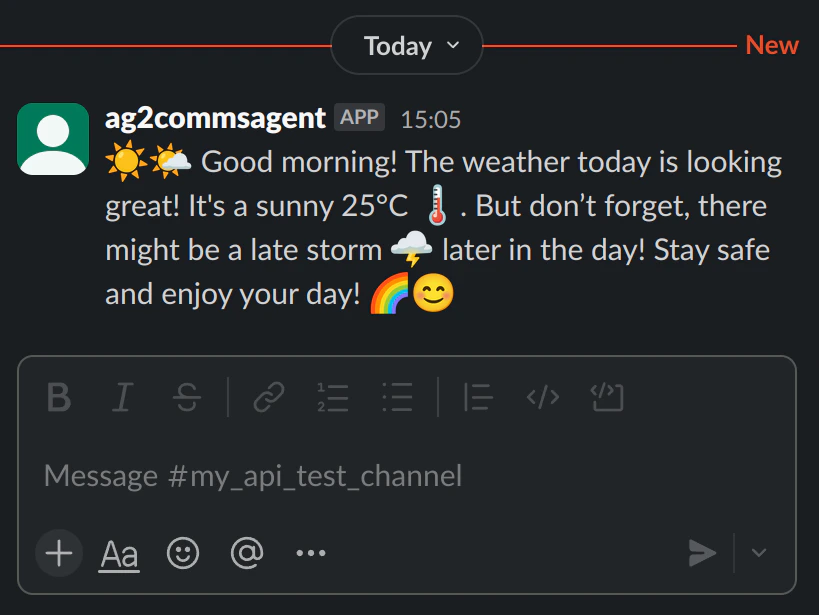
# Ask the SlackAgent to get the weather (using the get_weather tool) and then send a message out (using its SlackSendTool tool)
executor_agent.initiate_chat(
    recipient=slack_agent,
    message="Get the latest weather forecast and send it to our Slack channel. Use some emojis to make it fun!",
    max_turns=3,
)